

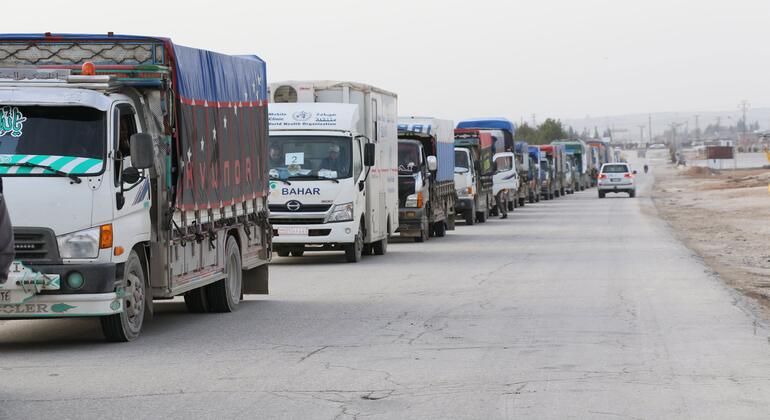
WFP Food Assistance in Syria Severely Impacted by Funding Shortfalls
The WFP food assistance program in Syria is facing a critical crisis as significant funding shortfalls have forced the United Nations World Food Programme (WFP) to slash its emergency food support. Millions of Syrians are now at an increased risk of hunger, and humanitarian organizations warn that these cuts come at a perilous time for the country’s most vulnerable populations.
Emergency Assistance Halved Amid Growing Needs
According to WFP officials, the agency has had to halve its emergency food assistance, leaving hundreds of thousands of vulnerable Syrians without reliable nutritional support. The reduction in WFP food assistance is not due to a decrease in needs but rather a persistent lack of funding. Marianne Ward, WFP Country Director in Syria, expressed deep concern, stating, “We are being forced to withdraw a vital safety net at a time when people need it most, with serious implications for food security, social cohesion, and stability, leaving the most vulnerable of families with even fewer options to cope.”
Families who were already struggling to survive are now forced to skip meals, reduce portion sizes, and rely on less nutritious food. Children are especially at risk, with prolonged food deprivation sharply increasing the chance of malnutrition and its long-term effects.
WFP’s Bread Subsidy Program Halted
The WFP’s bread subsidy initiative, previously one of Syria’s largest-scale safety nets, has also been discontinued due to funding shortfalls. This program supported over 300 bakeries by providing fortified wheat and ensured that subsidized bread reached up to four million people daily in some of the country’s most fragile regions. The loss of affordable bread is expected to force families into increasingly desperate coping mechanisms and could rapidly exacerbate hunger throughout Syria.
Food Insecurity Worsens Across Syria
Last year, the WFP reached 5.8 million people across all 14 governorates in Syria through its emergency food assistance, nutrition programs, livelihoods projects, and social protection initiatives. However, ongoing financial constraints have forced WFP to scale back operations from all 14 governorates to just seven. The agency estimates that more than seven million people in Syria are now acutely food insecure, including 1.6 million facing emergency conditions.
Regional Impacts: Refugees in Jordan, Lebanon, and Egypt
The WFP food assistance funding crisis is also having far-reaching effects beyond Syria’s borders. Many Syrian refugees living in neighboring countries such as Jordan, Lebanon, and Egypt still rely heavily on humanitarian aid. In Jordan, WFP has halted cash-based food assistance for 135,000 Syrian refugees living in host communities, while reduced support continues for about 85,000 refugees in camps. In Lebanon, refugee families struggle with rising living costs and limited income opportunities. Meanwhile, in Egypt, assistance for 20,000 Syrians has been reduced.
Samer Abdeljaber, WFP Regional Director for the Middle East, North Africa, and Eastern Europe, highlighted the growing difficulties: “Across the region, vulnerable families are facing the cumulative effects of prolonged crises, rising costs, and shrinking assistance.”
Urgent Funding Needed to Restore Critical Operations
To restore and sustain critical WFP food assistance operations, the agency urgently requires $189 million over the next six months. Timely contributions would allow the WFP to reach 1.6 million of the most vulnerable people, preserve vital nutrition programs, and maintain access to affordable bread—an essential lifeline for countless families at this pivotal moment in Syria’s fragile recovery.
Without urgent and sustained investment, WFP officials warn that years of progress could be reversed, driving millions deeper into food insecurity and threatening broader prospects for stability and recovery both inside Syria and in neighboring countries hosting refugees.
Conclusion: The Dire Consequences of Funding Gaps
The current funding crisis underscores the critical need for consistent international support to maintain WFP food assistance in Syria and across the region. As the humanitarian situation deteriorates, vulnerable families face increasingly harsh conditions. Without immediate action, the risk of hunger and malnutrition will only intensify, endangering lives and undermining efforts toward long-term stability and recovery.
This article is inspired by content from Original Source. It has been rephrased for originality. Images are credited to the original source.